Process Safety Management

We partner with clients to achieve full OSHA PSM compliance for a safe, secure and compliant facility.

Refining

Roadmap to Compliance

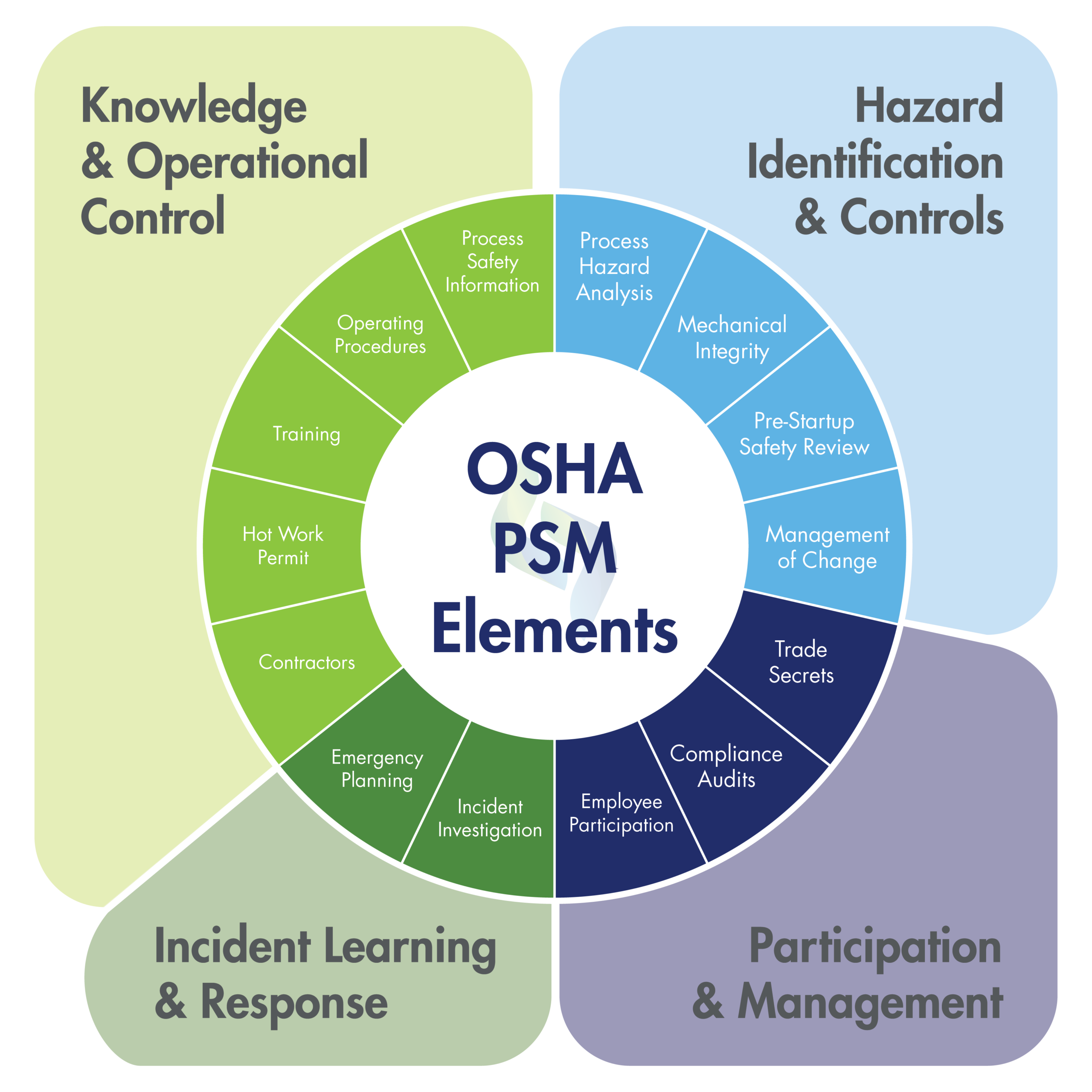
Under the guidance of the 14 OSHA PSM Elements, our Team can help you develop a roadmap for improvement to reduce risk and meet regulatory requirements.

In collaboration with Tormod, Hargrove’s Asset Lifecycle Management company, we can provide you with a comprehensive assessment, identify gaps in each element, and offer recommendations to eliminate those gaps.

Tormod

Our Certified Functional Safety Engineers are experienced with IEC 61508/61511, NFPA Standards, ISA 84 and the entire Safety Lifecycle.

12

Certified Teammates in Process Safety (TÜV or ISA)

8

Standards Committees with Hargrove Teammate representation

PSM Elements

Process Safety Management Elements

Hazard Identification & Controls

A PHA is a systematic evaluation to identify and analyze potential hazards associated with the processing, storage, and handling of highly hazardous chemicals. Using methods like HAZOP or What-If analyses, teams evaluate causes, consequences, and safeguards. PHAs must be revalidated at least every 5 years, with all recommendations tracked to completion.

A Mechanical Integrity program ensures that process equipment is properly designed, installed, and maintained to prevent failures. This includes inspection, testing, and preventive maintenance of tanks, piping, relief systems, and controls, following recognized engineering standards.

A PSSR is conducted before starting up new or modified processes to confirm everything is ready for safe operation. It is required when there is a significant change to a covered process involving highly hazardous chemicals that requires a change in the process safety information (PSI). This includes verifying equipment installation, ensuring procedures are in place, completing training, and resolving any identified hazards or recommendations.

MOC ensures that any process changes for chemicals, technology, equipment, facilities, personnel, and procedures that affect a covered process involving highly hazardous chemicals are reviewed for safety impacts before implementation. MOC is not required for “replacements in kind”. It requires updating documentation, training personnel, and obtaining approvals to prevent unintended hazards from changes.

Optimize your Site’s Asset Performance

PHA Screening Checklist

Is your Team initiating a PHA? Download this checklist to ensure you have the essential requirements in place.

PSM Audits

Every three (3) years, process safety audits must be conducted to maintain compliance with regulatory requirements and safety standards. Its purpose is to verify that systems to manage process safety are in place and functioning effectively, and to take any necessary corrective actions against those systems that are ineffective.

Participation & Management

Safety information cannot be withheld due to trade secret protections. Employers must provide all safety-related information necessary for employees and contractors to work safely, even when certain information is proprietary.

Compliance audits are conducted at least every 3 years to evaluate the effectiveness of the PSM program. Findings must be documented, corrective actions must be tracked, and records must be maintained to demonstrate continuous improvement.

Employee involvement is essential to an effective PSM program. Employers must develop a written plan that encourages workers to participate in PHAs, procedure development, and PSSRs. Employees must also have access to key PSM information so they can actively contribute to process safety and risk reduction.

Take a Proactive Approach to Safety

PSM Program

Implementation

Assess

Current PSM Program

Identify

Gaps in Each Element

Develop

Roadmap to Fill Gaps

Implement

Compliant PSM Program

Incident Learning & Response

Incident investigations identify root causes of accidents and near misses to prevent recurrence. Investigations must begin within 48 hours and result in documented findings and corrective actions that are tracked until resolved.

This element ensures preparedness for emergencies such as chemical releases. It includes response plans, evacuation procedures, alarm systems, and coordination with local emergency responders.

Keep Your Personnel Safe and Minimize your Environmental Footprint.

Complete OSHA Compliance

Download our Process Safety Management flyer.

Maintain Safety, Compliance, Quality, and Consistency in Your Operations

Knowledge & Operational Control

Contractors must perform work, maintenance, or repairs according to safety work practices on or near the covered process involving highly hazardous chemicals. Employers must account for contractors working in areas where there are covered processes. Employers must evaluate contractor performance, communicate hazards, and monitor compliance with safety procedures throughout the job.

Hot work permits control ignition risks from activities like welding or cutting. The permit ensures fire hazards are evaluated, fire prevention and protection measures are in place, and work is properly authorized before it begins.

PSM Training ensures that employees understand process hazards and proper procedures. Initial and refresher training at least every 3 years is required, along with documentation verifying employee competency and understanding.

Operating procedures outline how to safely perform tasks, including startup, normal operations, shutdown, and emergencies. They define operating limits, consequences of deviations, and must be reviewed and certified annually.

PSI provides the technical foundation for understanding process hazards involving highly hazardous chemicals. It includes data on chemicals from a safety data sheet (toxicity, flammability, exposure limits), process technology (flow diagrams, safe limits), and equipment design (materials, codes, P&IDs). Accurate PSI ensures that hazards are properly identified and managed. The PSI includes acceptable operating conditions to enable employees to identify deviations.

Run Your Plant With Confidence

Request a Consultation
Execute Customized Solutions
Experience Sustainable Results

Stay Informed

Read from our blog featuring Hargrove Teammates
  • The Real Cost of Process Safety

The Real Cost of Process Safety

By Cheryl Garcia, Process Safety Technical Consultant ________________________________________ Introduction When budgets tighten, Process Safety Management (PSM) is often treated as a [...]

Newsletter sign up

Subscribe to Our Newsletter

Stay up to date on the latest Hargrove News & Insights.

Connect With Hargrove Controls & Automation

Follow us on Linkedin