
the Process safety life-cycle
Keeping all personnel safe is your top priority. It’s our top priority, too.
Our TÜV Rheinland Functional Safety Engineers can walk you through the process safety life-cycle to assess and identify your current situation and implement solutions that will mitigate risk to your personnel, property, and surrounding area.

Safety – Mitigation
The Life-cycle of Process Safety
Depending on your manufacturing facility, your personnel could be exposed to various hazards in the workplace. These hazards can include extreme temperatures, potential chemical exposures, flammable substances, and sources of harmful dusts.
The Occupational Safety and Health Administration (OSHA) calls for process facilities to identify and address hazards in a process to reduce risk and satisfy the Recognized and Generally Accepted Good Engineering Practices (RAGAGEP).
OSHA acknowledges that the International Electrotechnical Commission (IEC) 61511 standard satisfies RAGAGEP. IEC 61511 establishes the process safety life-cycle.
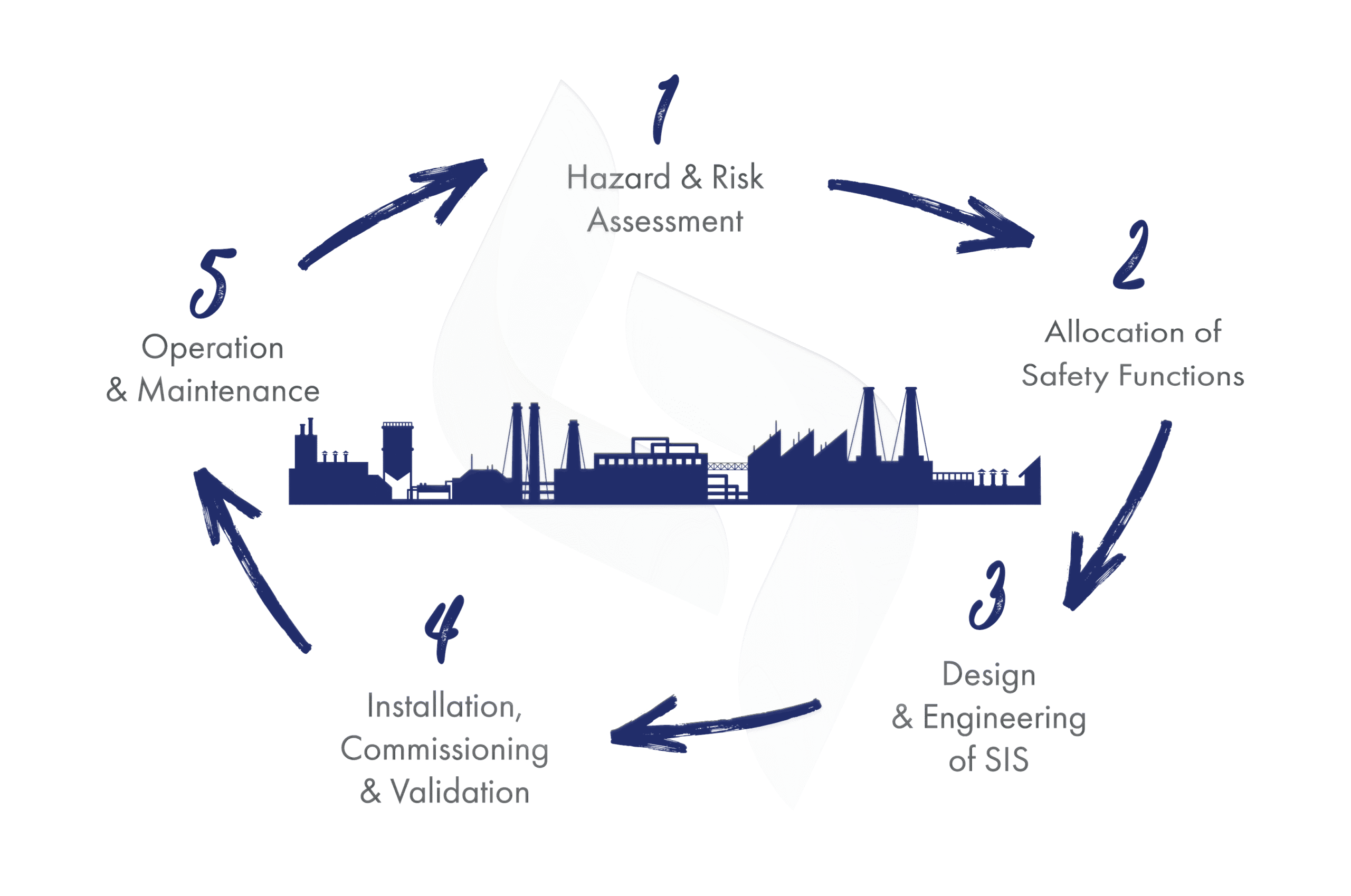
Step #1
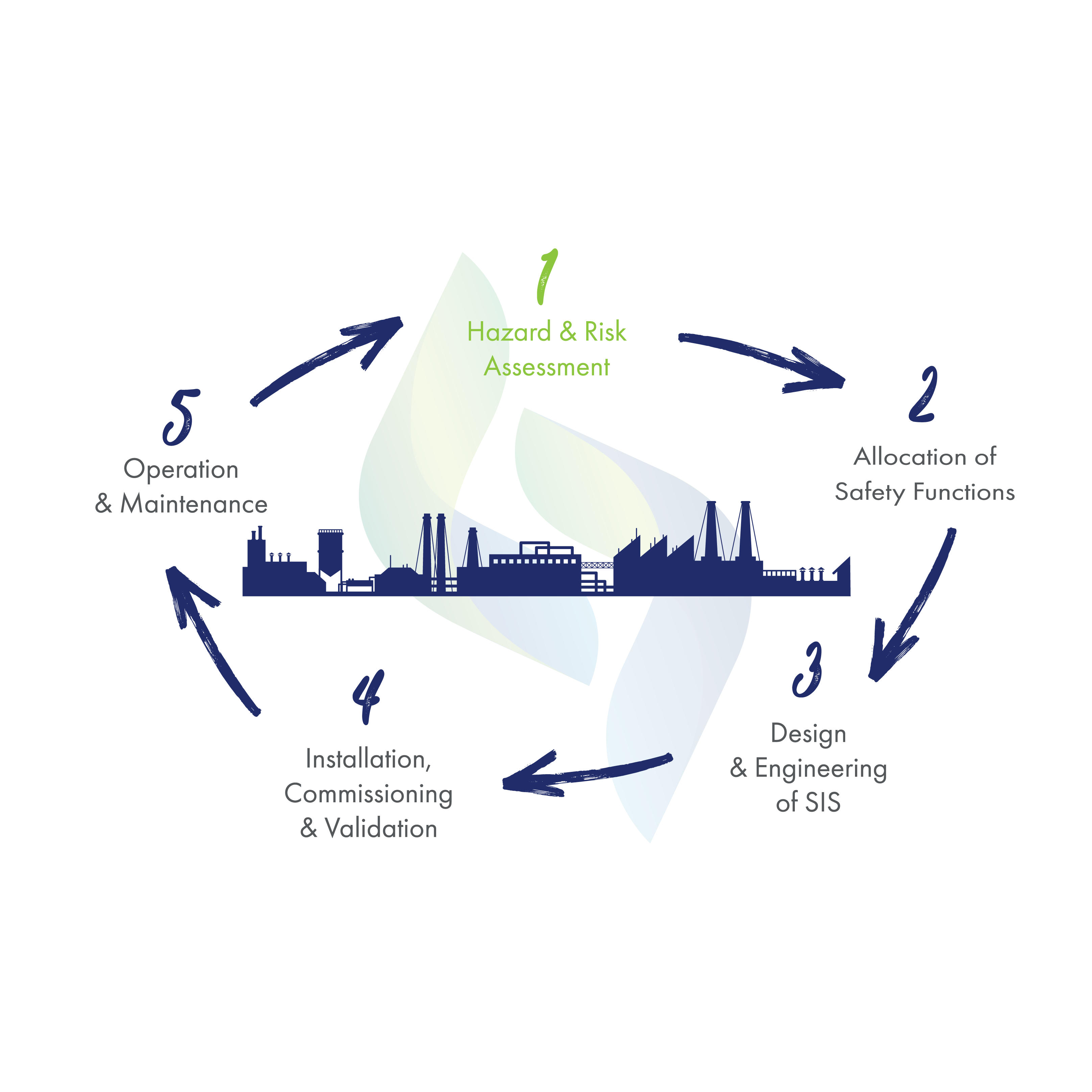
Hazard & Risk Assessment
If personnel are at risk at your manufacturing facility, you need to identify and mitigate any hazards that could cause harm.
Our Team of TÜV Rheinland Functional Safety Engineers, who are actively involved in industry standards committees, can evaluate your site for compliance and can facilitate a Process Hazard Analysis (PHA) to identify the causes and consequences of hazards in your process.
Each PHA has strengths and weaknesses that make it more applicable to different types of processes. Download our PHA Chart to determine which is right for your facility.
Checklists
Used for simple processes to evaluate small, low-complexity modifications to an existing
process.
What-If
Useful in analyzing procedures, especially if combined with a checklist format.
HazID
Helps identify risks early on in a design inherent to the process but doesn’t focus on the causes.
HazOP
A systematic review of a process, identifying cause / consequence pairs to uncover risks.
LOPA
Used to separate safeguards from Independent Protection Layers (IPLs).
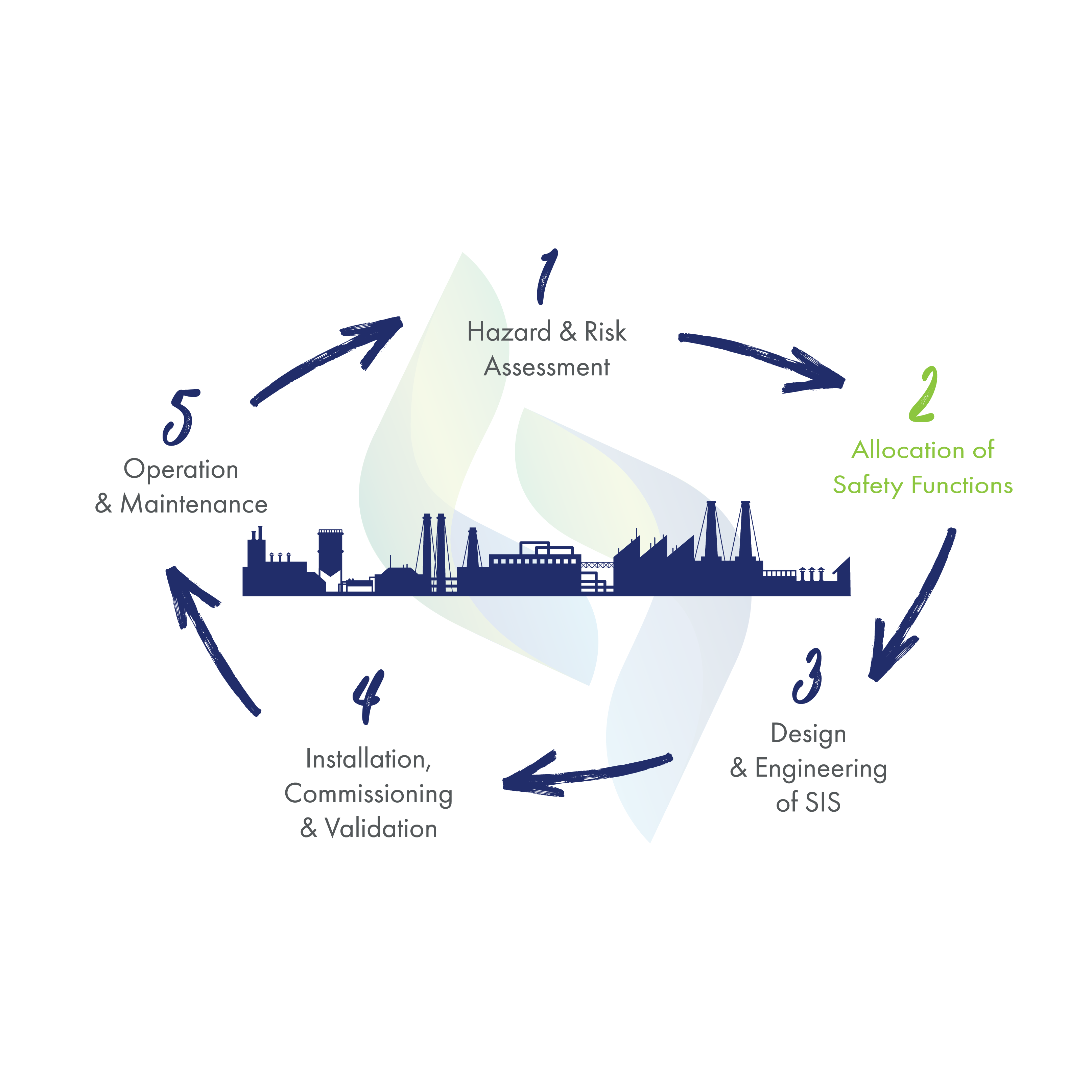
Step #2
Allocation of Safety Functions
Mitigation efforts, such as layers of protection, prevent the severity of potentially hazardous events. A Safety Requirements Specification (SRS) document chronicles the details necessary to design the safety functions to mitigate risk.
IEC 61511 issues safety and equipment verification requirements for process or high-hazard industries such as chemical manufacturing and oil & gas to reduce risk of the safety elements in the process. SIL calculations are used to verify if the safety elements were designed properly to meet the required level of risk reduction.
Step #3
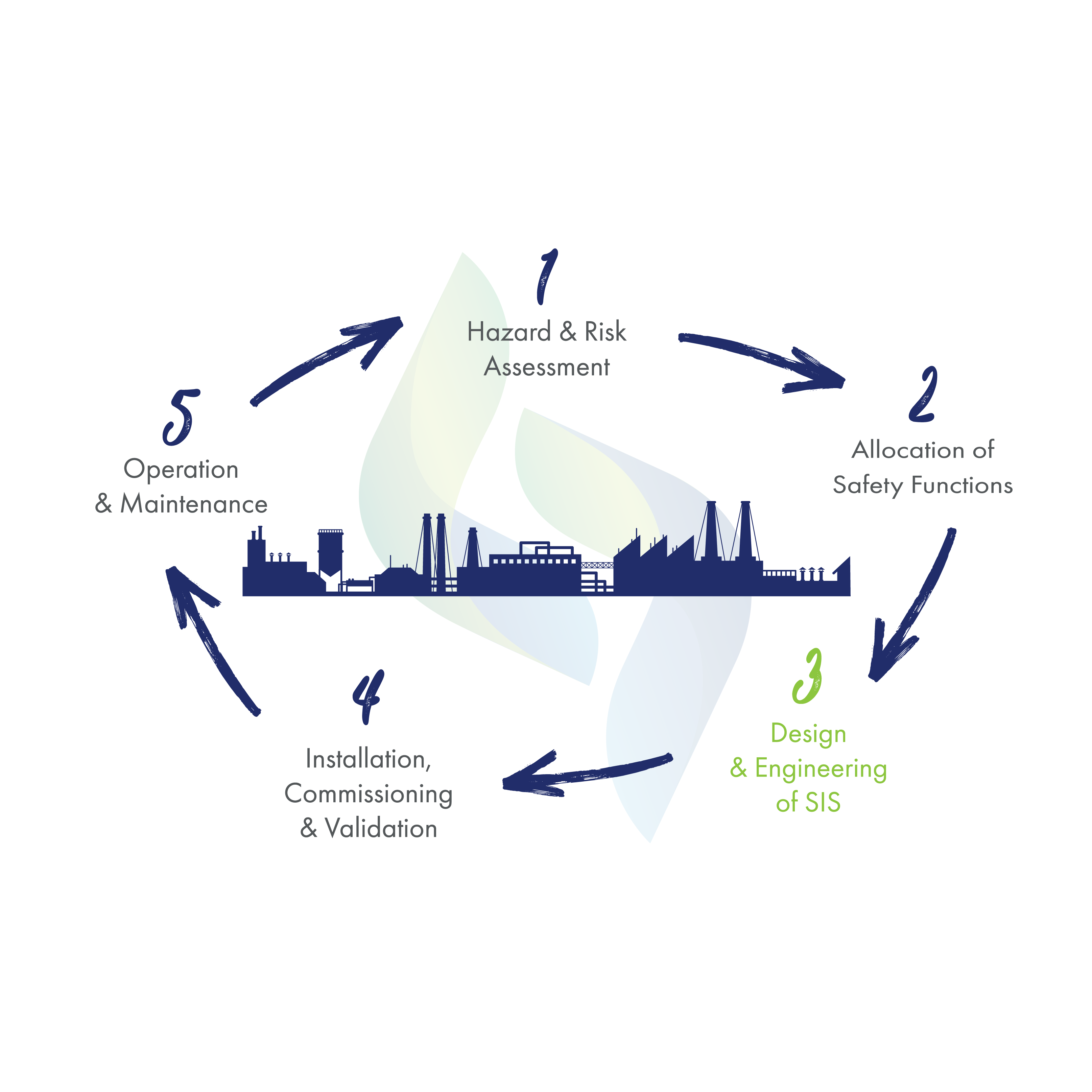
Design & Engineering of SIS
One method of protection against hazardous events is a Safety Instrumented System (SIS) which consists of Safety Instrumented Functions (SIF) designed to address a particular scenario. In order to apply these functions properly, adequate care must be taken to achieve protection against the hazard.
Configuring an effective SIS requires a lot more than just coding. There are many other factors that must be considered to meet the reliability requirements of a particular interlock while maintaining the operability of the process equipment. Our Process Safety Team has years of experience programming SISs on a wide variety of hardware platforms.
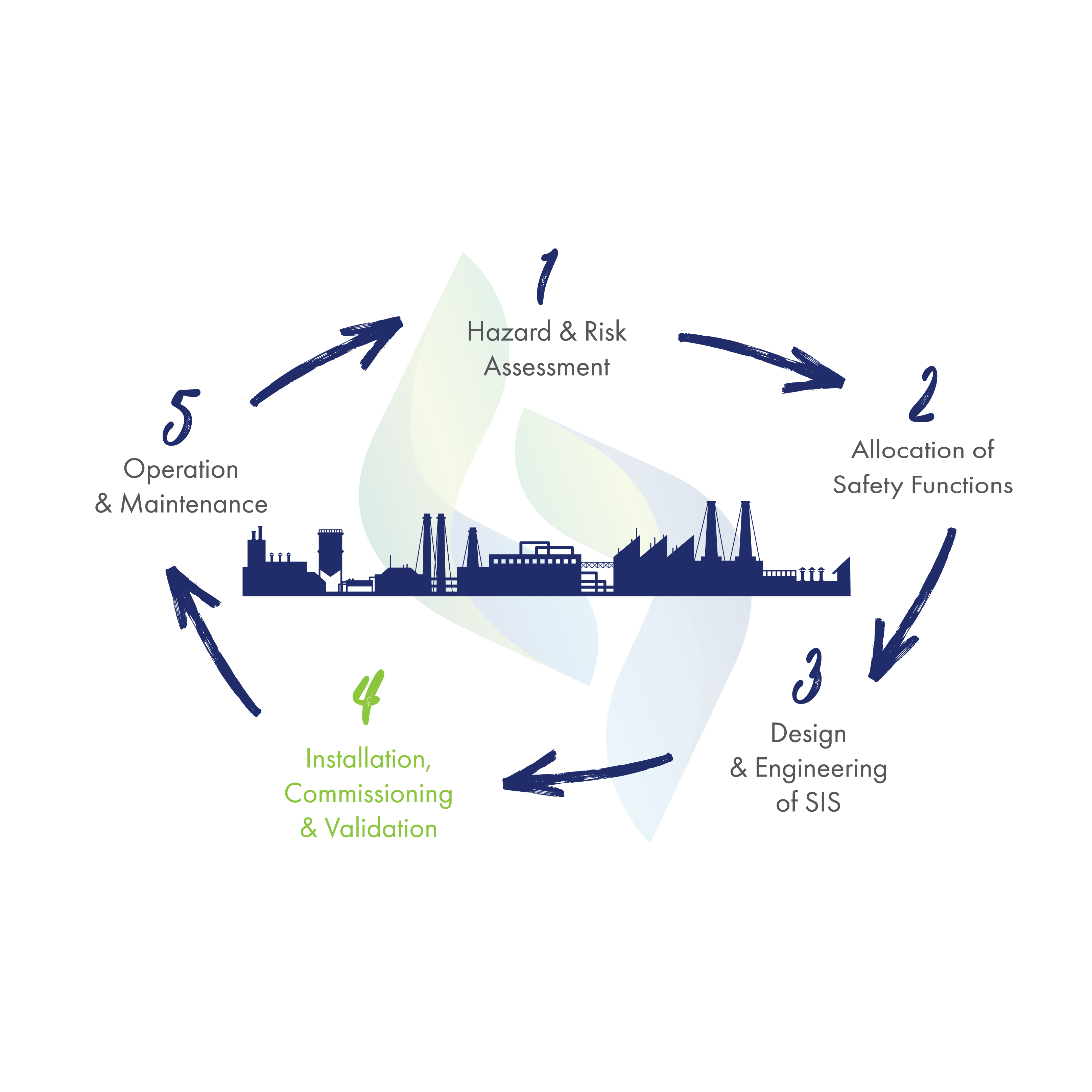
Step #4
Installation, Commissioning & Validation
A fully functional safety system is delivered to your facility. Functional safety assessments and Site Acceptance testing (SAT) are completed to validate the system’s proper operation and compliance with the SRS and industry standards.
Step #5
Operation & Maintenance
Identifying hazards in a process can mitigate risk and protect your personnel. Part of this process includes educating your operators about those hazards and mitigations.
OSHA standards that satisfy RAGAGEP require that anyone associated with a hazardous process be trained according to their involvement.

Project Spotlight
Circling the Life-cycle Gamut
A US chemical manufacturing company was planning to build a new unit on their existing property, which was licensed by another company. They had process design information and preliminary PFDs and were developing detailed P&IDs. They needed a Risk Assessment and any required mitigation measures. Even though they were a large and well-established company, their particular division did not have PSM Guidelines. Hargrove presented typical guidelines which the company took under advisement, to adapt and adopt as their own. The Hargrove Team completed A HAZID (preliminary HAZOP) to discover hazards inherent in the process, so process design modifications could be done to minimize risk, followed by a full HAZOP and LOPA on the fully developed P&IDs.
Taking the results from the LOPA, Hargrove developed a conceptual design of Independent Protection Layers (IPLs), and all of the supporting documentation required by industry standards (IES 61511 which satisfies OSHA RAGAGEP – Recognized And Generally Accepted Good Engineering Practice). Hargrove then specified and assisted in the detailed design of the SIS hardware and programmed the necessary Safety Instrumented Functions (SIFs) into the SIS. Hargrove performed Functional Safety Assessments to ensure all hazards were being addressed appropriately, developed Periodic Proof-Testing Procedures, and performed on-site commissioning to verify that all protective measures were in place and working effectively. The result was a system that monitored the process for hazardous conditions and provided protections to keep the employees, surrounding community, and environment safe from any harmful effects.

Subscribe to Our Newsletter
Stay up to date on the latest Hargrove News & Insights.
